School Building Maintenance & Modernization
School infrastructure impacts student achievement, health, teacher retention, school overhead costs, and local property values.
CURRENT STATE
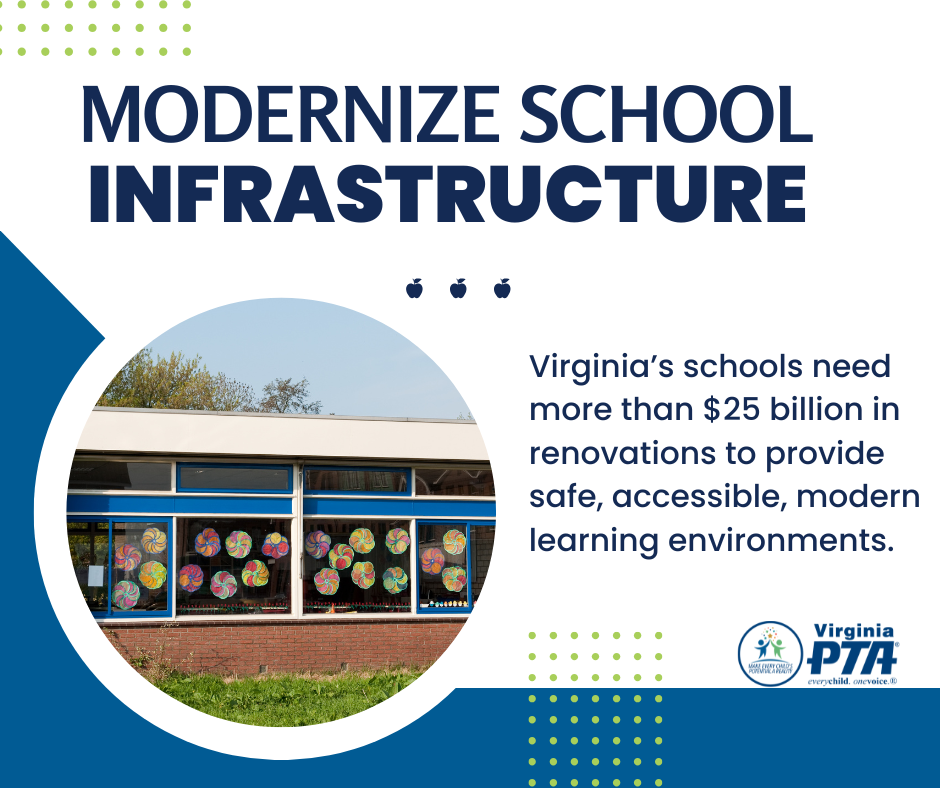
Data released by the Virginia Department of Education in 2022 revealed that 50 percent -nearly 1,000 school buildings- across the state are at least 50 years old. The 2022 report also cited that 22% of schools are not compliant with the Americans with Disabilities Act, 40% are at or above capacity and 5% lacked sufficient broadband capacity. It’s estimated that replacing these facilities would cost more than $25 billion. Virginia pays 10% of school construction costs, compared to the national average of 22%.
Virginia’s oldest school buildings are in our poorest communities which have limited ability to raise enough funding due to population decline and economic hardship. As a result many localities must decide between making critical infrastructure repairs or expanding educational resources to meet modern learning norms.
HISTORICAL PERSPECTIVE
Since the Byrd Road Act passed in 1930, Virginia’s cities/counties have financed the majority of school building construction through local property tax revenue. When the Byrd Road Act as passed it was agreed that the state would take responsibility for county road construction and localities would be primarily responsible for school construction. Through this time period many PTAs also helped raise funds to build and maintain their local school as well as address transportation challenges. In 1938 the federal government funded 45% of local construction costs. In subsequent decades, federal funding for capital costs significantly decreased to less than 1% of local costs. Beginning in the 1960s, the state moved primarily toward providing loans only – through the Literary Fund and the new Virginia Public School Authority (VPSA).
The Literary Fund, is a state-managed pool of money established in Virginia’s Constitution, that’s funded by unclaimed lottery winnings, criminal fines, and unclaimed property. It is used to provide low-interest loans to support school construction and debt service for technology, however, in recent years that funding was diverted to support the teacher retirement fund. During the 2022 session (per SB471) the Literacy Fund was changed to raise the maximum loan amount from $7.5 million to $25 million and the interest rate was capped at 2% thus making it easier for localities to finance large school renovation/construction projects.
RECENT WINS
In 2022 we won a historic $1.2 billion investment in school construction. This included the $400 million School Construction Grant Program, to pay for debt service payments on school projects completed or initiated during the last ten years and $450 million for School Construction Assistance Program to provide competitive grants of 10-30% based on the localities local composite index, demonstrated poor building conditions, commitment, and need. This program is primarily funded by 98% of gaming revenue from Virginia’s four new casinos in Bristol, Danville, Portsmouth, and Norfolk.
In 2023 we won passage of SB 1124 which requires the Board of Education to establish Standards of Quality for maintenance, operations,renovation, and new construction of school buildings. This legislation includes the percentage of the current replacement value of a public school building that a school board should budget for the maintenance and operations of the building.
In 2025 we secured an additional $150.0 million in casino revenues for a total of $310M in the 2024-2026 biennium for school construction grants.
PTA has a long history of being an outspoken advocate regarding the critical infrastructure needs of our schools at both the federal and state level. Virginia PTA believes that schools should be recognized and funded as an important component of our nation’s infrastructure. We call on the Commonwealth of Virginia to provide substantial and sustained investment to support school renovation, new construction and debt service costs to reduce overcrowding and provide for the regular repair and maintenance or upgrade of aging school buildings.
During the 2025 General Assembly Session we supported
- $290 million proposed in the Governor’s introduced biennium budget amendments. This would bring funding for the 2024-2026 biennium to $700 million.
- Legislation that would allow all cities/counties localities to hold a voter referendum to consider a local sales and use tax up to one percent to fund the construction or renovation of their local schools. This legislation has the potential to raise $1.5 billion annually. Under current law, only Charlotte, Gloucester, Halifax, Henry, Mecklenburg, Northampton, Patrick, and Pittsylvania Counties and the City of Danville are authorized to impose such a tax.
LEGISLATIVE REFERENCES
- 2023 VBOE School Construction Standards
- 2021 Virginia Commission on School Construction & Modernization
- 2021 Reopen & Rebuild America’s Schools Act (Federal Education & Labor Committee)
- 2020 Reopen & Rebuild America’s Schools Act (Federal Education & Labor Committee)
PTA POSITIONS & POLICY LETTERS
- Virginia PTA Resolution: Small Community Schools and Aging School Building Maintenance
- National PTA Resolution: School Facilities
- National PTA Resolution: Improved Infrastructure Around Schools
- POLICY LETTER: July 15, 2020 National PTA on Emergency Building Repairs
- POLICY LETTER: July 8, 2020 National PTA on HR2 Moving Forward Act
- POLICY LETTER: May 7 2020 National PTA on School Infrastructure in COVID-19 Stimulus
RESOURCES & RESEARCH
- 21st Century School Fund
- National Council of School Facilities
- 2021 State of Our Schools Report
- 2016 State of Our Schools Report
- 2020 Government Accountability Office Report on School Infrastructure
QUESTIONS: Email Vice President of Advocacy